Front of the sleeve / Poker
Side A · track 2
Hold'em and Omaha at 86 Casino
86 Casino on Spintex Road lists Texas Hold'em and Omaha, each played as a tournament and as a cash game. This track sets out how the two games and the two formats differ, then counts the cards.
the Sleeve desk · facts read 21 November 2026
What the list names
In May 2023 the French chamber of commerce in Ghana, CCI France Ghana, welcomed 86 Casino as a member under the name Lucky 786 Ghana Limited. The list of games the casino gave at that time names Texas Hold'em and Omaha, each as tournament play and as cash games. It also names Black Jack, Baccarat and American roulette. The list does not say what is dealt on any given day.
For a poker player, much is missing. No source the guide could read publishes a poker schedule, buy-ins, blinds, prizes or a count of tables. The Sleeve desk prints none of them and guesses at none. Anyone planning to play should ask at the casino before setting out.
Texas Hold'em, two and five
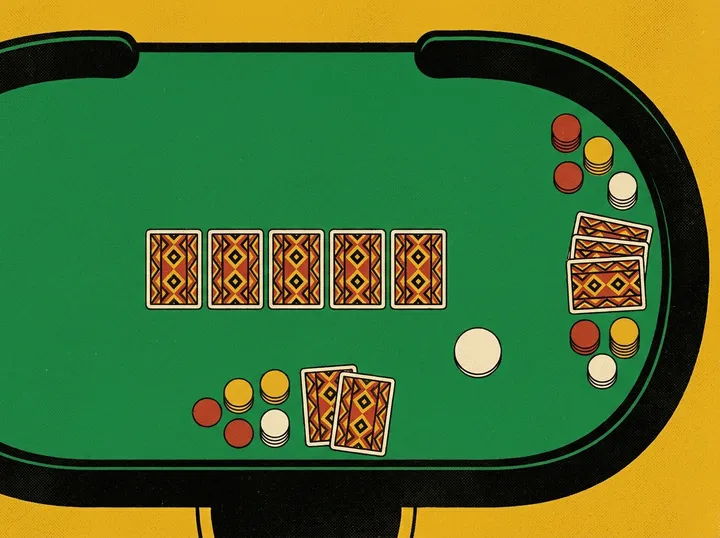
Texas Hold'em starts with two cards dealt face down to each player. Nobody else sees them. Five more cards then come face up in the middle of the table, and every player shares them. Those are the community cards.
At the end, each player makes the best five-card hand from seven cards: the two private ones and the five on the board. Any mix of them counts. A hand can use both private cards, one of them, or none at all and play the board alone. That freedom is what separates Hold'em from Omaha. How 86 Casino deals the game, and its house rules, are not published, so the general pattern is all this track can describe.
Omaha, two from four
Omaha deals four private cards to each player instead of two. The board is the same: five community cards, face up, shared by the table. The difference sits in the rule for making a hand. Every Omaha hand must use exactly two private cards and exactly three from the board, no more and no fewer.
Players who come from Hold'em often slip here. They see four hearts on the board, hold one heart, and read a flush. In Omaha that hand is no flush, because only one private card fits and two are required. The same goes for a straight that needs four board cards. Reading each hand as two plus three, every time, avoids the error.
Cash game or tournament
The two formats run on different chips. In a cash game the chips stand for money. A player can sit down between hands, and can get up and leave between hands too.
A tournament works the other way. Every player buys in for the same stack, and those chips have no cash value. Play continues until the chips have gathered with the last players at the table.
For one visit, this shapes the plan. A cash game is open-ended: nothing in the format stops a player from staying longer or reaching into a pocket again. A tournament carries a fixed cost, the buy-in, known before the first hand. Either way, decide the sum and the time before sitting down, and keep to both. The amounts at 86 Casino are not published, and this guide prints none.
Who pays the house
Poker is played between the players, not against the house. A house that runs the game usually takes its share in one of two ways: a fee, or a cut taken from each pot.
How 86 Casino charges for poker is not published. Neither are buy-ins or table limits. Ask at the casino, before sitting down, which method applies and how much it comes to. In a long cash game a cut of every pot adds up, so the answer matters for the budget of a visit.
The cards in numbers
A 52-card deck gives 1,326 possible two-card starting hands in Texas Hold'em. Of these, 78 are pairs, about 5.9 percent, or one deal in 17. Another 312 are suited, about 23.5 percent. Any one pair, such as two aces, can come in 6 ways, which makes it one deal in 221. Omaha, with four private cards, has 270,725 combinations.
At the table this means long stretches of ordinary cards. A player waiting for two aces will, on average, sit through many deals, and the numbers promise nothing about the next one. Each deal is fresh. Patience is part of the game, and so is folding most hands without fuss. In Omaha the far larger number spreads the deal across many more starting hands, so no single holding comes often.
Hand counter
Pick Texas Hold'em or Omaha and a kind of starting hand, and the counter shows how many combinations there are and how often that hand comes in a deal. It is arithmetic from a 52-card deck, nothing more, and it predicts no hand.
Starting hands, counted
| Hold'em hand | Combinations of 1,326 |
|---|---|
| Any pair | 78 |
| Two aces | 6 |
| Same suit | 312 |
Combinations from one 52-card deck before any card is shown. Nothing here predicts a result.
Short questions on poker
Does 86 Casino have poker?
Its list of games includes Texas Hold'em and Omaha. What is dealt on a given day is not published.
Are there poker tournaments?
The list names both tournament and cash games for Hold'em and Omaha. No schedule, buy-in or prize is published, so ask at the casino before setting out.
What is the difference between Hold'em and Omaha?
Hold'em gives two private cards, and a hand may use both, one or neither. In Omaha each player gets four and must use exactly two, with exactly three from the board.
How often is a pair dealt in Hold'em?
About one deal in 17. Of the 1,326 possible two-card hands, 78 are pairs.
What does the house charge for poker?
That is not published. A house usually takes a fee or a cut of each pot, so ask which applies before sitting down.